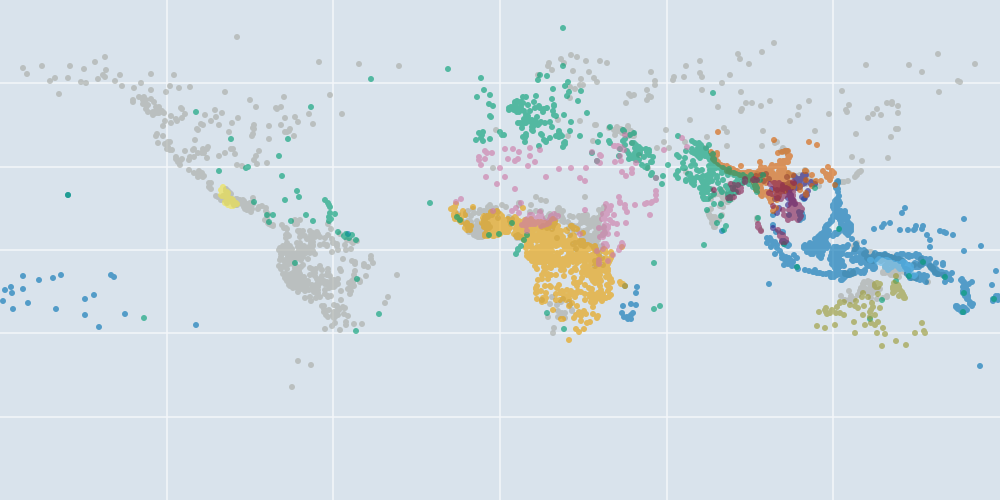
How to read the world language map
This world language map lets you tap any point on Earth and see which languages are spoken there. Each coloured shape is the traditional area of one language, and the colour tells you its language family. Zoom in, tap, and a list opens with every language whose area covers that spot, with links to a page for each one. You can also search for a language by name, or press Near me to see the languages around you.
Think of it as a language map rather than a border map. Languages do not stop at national frontiers, and many of the shapes cross several countries. Use the family filter to show one family at a time, which is the quickest way to see how a single group of related languages spreads over the world.
The map shows 4,008 languages as areas and 2,714 more as single points, out of 6,722 living languages in Glottolog. They belong to 211 named families, plus 103 isolates: languages with no known relatives. The ten largest families have their own colour, and between them they hold 71% of the languages with a page here.
- 6,722living languages
- 211language families
- 103language isolates
- 237countries and territories
Where a language has an area, it comes from 13 published language atlases, digitised by the Glottography project. Each area keeps the name and year of its atlas, which the map shows when you tap it. See every source and licence.
What is a language family?
A language family is a group of languages that grew from one older language, in the same way that French, Spanish and Italian grew from Latin. The languages in a family share many words and grammar patterns that are too regular to be chance. This language family map colours every area by its family, so related languages share a colour wherever they sit in the world.
- Indo-European: 485 languages, including Spanish, English and Hindi.
- Sino-Tibetan: 496 languages, including Mandarin Chinese, Wu Chinese and Yue Chinese.
- Afro-Asiatic: 332 languages, including Standard Arabic, Egyptian Arabic and Levantine Arabic.
Families come in very different sizes. The largest, Atlantic-Congo, has 1,367 languages, while number 5 on the list, Afro-Asiatic, has 332. At the other end are the 103 language isolates, which have no known relatives at all.
The biggest language families
These families have the most languages. Each has its own page and map.
- Atlantic-Congo languages map (1,367 languages)
- Austronesian languages map (1,226 languages)
- Sino-Tibetan languages map (496 languages)
- Indo-European languages map (485 languages)
- Afro-Asiatic languages map (332 languages)
Countries with the most languages
Papua New Guinea has 864 living languages on this map, more than anywhere else, followed by Indonesia (708), Nigeria (528) and India (456).
Papua New Guinea alone has 864 living languages, about 13% of the 6,722 on the map, and a population of about 10 million. Rugged land, islands, many separate communities and a long history of settlement all help languages to multiply, and large countries such as India and Nigeria hold many languages because they hold many peoples. A language spoken in several countries is counted in each, so country totals add up to more than the world total.
- Languages spoken in Papua New Guinea (864 languages)
- Languages spoken in Indonesia (708 languages)
- Languages spoken in Nigeria (528 languages)
- Languages spoken in India (456 languages)
- Languages spoken in China (407 languages)
- Languages spoken in Cameroon (306 languages)
The most spoken languages on the map
Speaker numbers are approximate, and they come from Wikidata with the source and year it cites. These have the highest figures there. Most are counts of first-language speakers; the same language can rank very differently once people who learn it later are included, which is why English and other widely learned languages often move up in other lists. Sources also disagree by millions for the same language, because they count in different years and define a speaker differently. Only 1,593 languages have a figure at all, so about 76% of languages on the map show none.
- Where is Mandarin Chinese spoken? (about 918 million speakers)
- Where is Spanish spoken? (about 485 million speakers)
- Where is English spoken? (about 379 million speakers)
- Where is Hindi spoken? (about 341 million speakers)
- Where is Standard Arabic spoken? (about 335 million speakers)
Languages at risk
Glottolog gives an endangerment status to 6,691 of the languages here. 4,003 of them are threatened, shifting, moribund or nearly extinct, and 709 are moribund or nearly extinct, with no children learning them. The status is shown on each language page.
Many languages with few speakers are no longer being passed to children, and when the last fluent speakers die the language goes with them, along with songs, place names and ways of describing the world that exist nowhere else. Glottolog assigns these statuses from published surveys of each language. They are a snapshot, and some communities are now reviving languages once thought lost.
Why areas overlap, and what the map cannot show
The shapes on this map are generalisations. 4,008 languages (60%) are drawn from 13 published atlases, many of them decades old, and each atlas drew its areas for its own purpose. Where two languages share a valley, a city or a border region, their areas overlap and the colours mix. The remaining 2,714 languages (40%) have no open area map and appear as single points instead.
An area says where a language has traditionally been spoken, not that everyone inside it speaks it. Big cities, migration and the spread of national and world languages mean that most places hold many more languages than the map shows. Speaker numbers on each page also come from varying sources and years, so treat them as estimates, and use the source named for each area to judge how old and how detailed it is.
Some of this is sensitive. Whether a variety counts as a language or a dialect, and where its area ends, can be disputed, and some communities see the question differently from outside researchers. The map follows Glottolog and the cited atlases and does not take a side.
Frequently asked questions
How many languages are there in the world?
Nobody knows exactly, because where one language ends and another begins is partly a judgement call. This map includes 6,722 living spoken languages from Glottolog v5.3. Glottolog also lists extinct languages, sign languages and artificial languages, which are left out here. Other catalogues, with different rules, give different totals.
Which language has the most speakers?
On this map, Mandarin Chinese has the highest figure: about 918 million first-language speakers (Ethnologue, 2019, via Wikidata). That is a count of first-language speakers, meaning people who grew up with it. If you count people who speak a language as a second or later language too, English is usually placed first in other sources, and the order depends on the year and the definition.
Which country has the most languages?
Papua New Guinea has the most: 864 living languages on this map, about 13% of the 6,722 total. Indonesia (708), Nigeria (528) and India (456) follow. A language that is spoken in several countries is counted in each of them.
What is a language family?
A language family is a group of languages that descend from a common ancestor, the way cousins share grandparents. English, Spanish and Hindi are all in the Indo-European family. Linguists group languages by regular sound and word patterns, not by how they look or where they are spoken. There are 211 named families on this map, and the biggest, Atlantic-Congo, has 1,367 languages.
What is a language isolate?
A language isolate is a language with no demonstrated relatives, so it forms a family of one. Glottolog lists 103 of them among the languages on this map. Basque in Europe is the best-known example. Isolates are not necessarily old or odd: the evidence needed to link them to another language has simply not been found.
Why do language areas overlap on the map?
Because real languages overlap. Cities, borders and trade routes put many languages in the same place, and people often speak more than one. Each area comes from a published atlas, and where two atlases or two languages cover the same ground the colours mix. Areas are also generalisations, many drawn decades ago, so an area never says that everyone inside it speaks the language.
Why does a language show as a dot instead of an area?
No area map that we are allowed to use covers it. 2,714 of the 6,722 languages on the map are marked by a single point at the position Glottolog gives. The largest groups are in Eurasia (850), Africa (648) and Papunesia, the Pacific islands and New Guinea (628). For some regions the only digitised atlases carry a non-commercial licence, so they are not used.
Where do the speaker numbers come from?
They come from Wikidata, retrieved on 2026-10-13, and only 1,593 of the 6,722 languages have one. Each figure is shown with the source and year that Wikidata cites, and it is always approximate: counts differ hugely between sources, and the question of who counts as a speaker has no single answer.
How accurate is the language map?
It is a good guide to where a language is traditionally spoken, and a poor guide to how many people speak it in any one place. 4,008 languages are drawn from 13 published atlases, and each atlas has its own date, method and gaps. People move, cities mix languages and languages fade, none of which an area on a map can show. Treat the map as a starting point and check the source atlas, which is named when you tap an area.
Is a dialect a language?
There is no neutral rule. Linguists often say that if speakers can understand each other easily the varieties are dialects of one language, but politics, history and identity also play a part, and the test can give different answers in different places. This map follows Glottolog, which sets its own criteria for what counts as a language, so other catalogues may split or join some of these.